Internet Scholars – The One Day Researchers

There I was reading an article posted on social media by a ‘friend’ and it made me aghast at the impudence of a man to write on something with little or no knowledge of it at all. His premise was the recent research that he has started doing on the Internet and the source was reading of a few articles, with no better foundation for his claim. The writer wrote in ‘Round Table India – For an Informed Ambedkar Age.’

There is a crop of Internet Scholars and writers getting their two-minutes of fame for their blog. Their claim to fame is not well-founded real research. It is a couple of days of browsing the Internet, culling out the portions that can catch a reader’s imagination by way of being so notorious and controversial, keeping their writings in circulation. It is a shame that there are people who actually find it worth their while to endorse such writings. Worst part is that so called ‘liberated and secular Indians’ (read Hindus) have such abhorrence for their own identity that they try to show themselves above it by bashing their religion, history, and mythology, leaving it bloody.

The texts and thesis of Sanatan Dharma (also popularly known as Hinduism) are not limited to stul gyan (material, coarse interpretations). There are many sukshm or subtle revelations, each requiring a deep analytical study. Add to that is the ancient language, which is open to many interpretations. Each character and action in the ancient literature has a saga of its own. There was a practice in the ancient times, wherein, only a guru could reveal the scriptures and their meaning, in all its subtleties, to their devoted disciples. The extent of the disclosure also depended on the disciples’ respective calibres. The four varna or caste was based on the ability of the individual to devote self to various tasks. Only individuals with brahmanic bent of mind, ready to spend a lifetime in dedicated study of the scriptures, devoted to learning, with complete focus could partake this process of divulgence of spiritual knowledge.

Let me explain it by taking an analogy of the current education system. In Indian schools, a pupil has to go through all theoretical subjects, like Language, Social Sciences, Sciences, and Mathematics-Algebra, until 10th standard, before being presented with limited choices in senior school. A statistics of pupils in these classes will reveal a parabola curve, with most people averaging on mediocrity, some doing really badly, while a few excelling. This system of education is not a right yardstick of a person’s true potential.

Exactly opposite was the foundation of the ancient system of learning. Education was customised as per the interests of individuals, enhancing their skills in their chosen vocation. For example, Parashuram was born as a Brahmin, but he lived his life as a Kshatriya. Vishwamitra on the other hand was born to a Kshatriya, but chose to become a Brahmin. Shabri (A woman born to Shudra parents) was running an Ashram and chose to be a Brahmin. This system was maybe, corrupted thousands of years ago, and this corrupted system was perhaps present during Mahabharata.

Addressing the same system, Lord Krishna did apprise Arjun that anyone can attain Him as their spiritual destination. Bhagavad Gita, Chapter 9, verse 32 ‘O son of Pritha, those who take shelter in Me, though they be of lower birth—women, vaishyas [merchants] and shudras [workers]—can attain the supreme destination.’ When He used the term, ‘lower birth’ it was contextual as per Arjun’s understanding of the existing system prevailing, clearly indicating that in devotional service there is no distinction between the lower and higher classes of people. In the material conception of life, there are such divisions, but for a person engaged in transcendental devotional service to the Lord there are not. Everyone is eligible for the supreme destination. The soul is without material substance, with no gender, caste, creed, or colour. The soul should try to attain Him.

I am also presenting a link of a viewpoint by a fellow blogger explaining the caste and varnas.

Going back to the article that infuriated me, I want to present the argument on two major points. First, the writer mentioned the painting by Akram Hussain of Lord Krishna in a bar surrounded by bikini-clad women, and how it was taken down from Ravindra Bhavan in Guwahati’s State Art Gallery after protests from the right wing groups. Need I remind what happened on January 7, 2015 for some Charlie Hebdo cartoons? Second, the writer talks about how “…most of the characters in Bhagavad Gita are born illegitimately, and during the Mahabharata period, adultery, rape, murder, killing etc., was rampant. …” Really?! Characters in Bhagavad Gita? Or do you mean, Mahabharata? So much for the informed writing! Before I address point one, let me say that you just have to look at the recent history and literature around the world to know that it is replete with many such cultural incidents. Look up the phrase, Droit du seigneur, ‘Right of the Lord’ in European history. The man also talked about niyoga. There are terms like polyandry, polygyny, and levirate marriage in various societies across globe and find mention in New Testament. Different times, different cultures, different practices. More informed study into each is called for.

Coming back to first point, Krishna Raasleela, and how it was depicted in Akram Hussain’s painting. We need to understand that some cultural portrayals through the generations have shown a youthful Lord Krishna dancing with the gopis or the milkmaids of the village in raasleela. Here, we need to put the chronology right. Lord Krishna was all of three years old when He moved to Vrindavan. He started doing raasleela at around 7 years of age with the Gopis, who were all 16-17 years or older. His maternal uncle, Kamsa, invited Him to Mathura for a wrestling match at the age of 10, and He moved to Mathura. After killing Kamsa, Lord Krishna with brother Balarama, went to ashram with Guru Sandeepaani muni for education. Let us give it a perspective. Remember when you were 15 years and above and had a sweet little niece or nephew around the age of seven. Be reminded, or imagine when this cute little thing sang a romantic song for you, learned from a recent movie. What would be your feelings? Sexual? Nah. Amusement? Maternal? For sure. You will be in splits, enjoying the sweet antics of this child. You will go to the extent of telling every relative and will urge the little kid to repeat the act. Multiply this feeling a thousand times, add fervour and devotion to it. That is God’s raasleela.

Pointing fingers towards a culture or any scripture is not a good idea and most people should refrain from this. We Hindu believers will not do a Charlie Hebdo. We will not go on a killing spree. However, we will protest, and protest we must. This article is my protest against the plundering of my religious scriptures and figureheads by anyone. I mentioned in my earlier articles (So You Think You Are The Saviour, and A Guru, A Guide, the Intent) to find the right guru to learn a scripture or teachings. Idea Internet Network, IIN, will not work here. Cultural and religious condemning is in bad taste. None of you is a saviour. Worry about your personal growth and learning, by learning right. Stop trying to change the world and minds.

Some famous quotes on this sentiment.


“Be the change that you wish to see in the world.”

― Mahatma Gandhi

“Everyone thinks of changing the world, but no one thinks of changing himself.”

― Leo Tolstoy

“The world as we have created it is a process of our thinking. It cannot be changed without changing our thinking.”

― Albert Einstein


Conclusion

Misinformation or pillage of any religion or scriptures is unwarranted. I cannot show my discontent enough. More so, when I find that people stabbing their own in the back, especially fairly peaceful Hindus. Nowhere have I seen a sect, except Hindus in India, who take pride in denigrating their own. I protest, and will continue to do so. Find another vocation, and stop it.

||Sarvam Sri Krishna Arpanamastu||
Posted in In my Opinion, Spiritual | Tagged , , , , , , , , , , , , , , , , , , , , , , | 1 Comment

Flash or HTML5 – Future of eLearning

Overview

This topic has been discussed to death since 2010 or even earlier. The future appears to be leaning towards multi-devices and multi-access learning. The corporates are encouraging a BYOD (bring your own device) trend, with the staff accessing corporate applications on multiple devices. Mobility is in major demand and there is a demand to access knowledge when and where is needed and on the devices of their choice. This makes it imperative that learning becomes as dynamic. The buzzwords are BYOD, responsive designs, and augmented reality etc. What are the implications of these on learning design frameworks and tools? Does it mean that all our legacy eLearning content in Flash is dated and need to be moved to HTML5? Is HTML5 ready to take up the challenge? Let us explore.

What is HTML5

HTML5 is the latest version of HTML. However, when we say HTML5, we are referring to HTML5 stack comprising three technologies – HTML5, CSS (cascading style sheets with CSS3 being the latest), and JavaScript. HTML is the markup language, and CSS defines the style, looks, and formatting of the markup document. JavaScript is the programming language. Together, they provide the user experience on a web-browser.

Let us delve a little more into HTML5.

HTML5 Features

  • The fifth version of HTML has new tags like <canvas> and <SVG> elements that can be placed in HTML code like the <image> tag.
  • HTML5 does not require any plugins unlike Flash, which works with browser plugins.
  • HTML5 supports drag and drop activity within the code itself.
  • <audio> and <video> tags allows placing audio and video files directly in the HTML code.
  • Most smartphone browsers are compatible with HTML5.
  • Multi-device and multi-access requirements find support with HTML5 with responsive web design.
  • HTML5 is the open standard adopted by W3C and is being incorporated in all new browsers.

HTML5 Limitations

  • Poor performance by HTML5 app. This is due to limited access to a phone’s hardware, especially with heavy graphics use.
  • Device fragmentation can be an issue, as many device manufacturers and users have not updated their OS. The course or application loses the ability to ‘write once and run anywhere’ due to this fragmentation.
  • HTML5 has limited graphics and animation delivery. The use of heavy codes in CSS and JavaScript for writing a simple animation can take up hours.
  • HTML5 cannot handle the development of sophisticated native app for iphone or androids like Flash or Xcode.
  • There are no standard format for HTML5 video. There are three main video formats (MP4/H264, Ogg/Theora, and WebM/Vp8) supported by HTML5 browsers but unfortunately no single format works in all browsers.
  • HTML5 development power is in the JavaScript. JavaScript has been around for many years and it is the JavaScript features that you see in HTML5.
  • Each HTML5 course has different experience on different browsers.

Flash and eLearning

Flash has been on the eLearning scene for decades now. Released in 1990s, Flash player was a browser-based plugin for displaying various graphics and animations, mostly vector-based. With its popularity with animators due to its rich graphics and creative medium for animations, it gained acceptance in the eLearning industry for web-based training and computer-based training. Flash player continued to offer new features and developers continued to exploit these features to create interactive, experiential, rich-media content. When Adobe released desktop Flash runtime called Adobe AIR or Adobe Integrated Runtime, it opened doors for creating content as standalone applications for desktops. The same AIR is now used for creating native applications for mobile devices, including iPhones and iPads.

The robustness of Flash player and programming has seen creation of media-rich motion graphics, animations, 2D and 3D graphics, and highly interactive eLearning content. It is believed that the Flash runtimes are particularly and uniquely suited for creating and deploying games with console-quality graphics and deploying premium video. A quote from Ray Pastore (Assistant Professor of Instructional Technology, University of North Carolina, Wilmington), “…eLearning tools such as articulate, etc. do NOT do what flash does and neither does HTML5 – they are not even close to as powerful. So those are not options to replace Flash.

If you are talking mobile, flash is one of the best options for publishing to both android and iphone/ipad – at least if you are trying to publish native apps. If I am developing a sophisticated app for the ipad, I would probably use either Flash or Xcode because HTML5 cannot handle it…”

This discussion about the death of Flash has been on for a few years and yet, eLearning development in Flash continues.

Future of eLearning

It is not a hype, we are indeed moving towards mobile devices for connectivity, learning, and business, and BYOD is the future norm. However, desktops are not being phased out just yet. We may have a decade or more before mobile devices completely take over. Here is what I think is happening:

  • People are delving into HTML5, some more than others.
  • There is a demand for responsive design, but the cost of development and the skillset limitation is not a supporter.
  • Native applications are better published using Flash CS6. People prefer native apps to HTML5.
  • Flash supports gaming better.
  • HTML5 still has a long way to go and we may be looking at HTML6 or even 7, before Flash is outdone. Flash would be evolving too.

Conclusion

I do not see HTML5 replacing Flash. There will be a co-existence and HTML5 still has a long way to go before it provides capabilities of Flash. Why should we go with one over other? Choose a mix using HTML5 and Flash to complement each other. Utilise the features of both and create a better solution depending upon the requirements like mobility, native application, desktop, animations, interactivity, ROI etc.

Sources:
http://www.latitudelearning.com/Blog/tabid/1761/Article/1102926/flash-is-dead-for-elearning-what-to-do-with-so-much-elearning-content-developed.aspx
http://www.epathlearning.com/assets/eLearning_HTML5_the_end_of_Flash.pdf
http://elearningindustry.com/7-powerful-reminders-finally-adopt-html5-corporate-elearning
http://wwwimages.adobe.com/www.adobe.com/content/dam/Adobe/en/devnet/flashplatform/whitepapers/flash-runtimes-roadmap.pdf
http://elearningindustry.com/is-html5-ready-for-the-elearning-industry

||Sarvam Sri Krishna Arpanamastu||

Posted in Technical | Tagged , , , , , , , , , , , , , , | 1 Comment

Informal or Social Learning and xAPI

Overview

Informal learning has been around for forever and is a part of our daily lives.  The advent of social media in the current digital age has added a new dimension to informal learning, making it more effective.  Most of the informal learning is accidental and directionless. However, organizations and learning services providers are beginning to tap this unexploited and magnificent source of information and making this learning intentional, bringing in a paradigm shift in education.  Collaborative platforms like wikis, social networking tools, blogs, YouTube etc. form an integral part of informal or social learning.

Informal learning is like having a GPS, rather than a roadmap, used for finding your own route.  The premise is that without formalizing informal learning by pushing it, the learner should be given the freedom to pull the information as per the learning needs.  Pulling information gives more control to the learners who set their own objectives and learn what they really need to know.  Greatest challenge for a learning and development team, or learning services provider, is to move from the traditional roles of designers, developers, deliverers, and managers of learning to facilitators of learning, and performance consultants.

Introducing Experience API

The learning methodology is constantly changing, and a blend of approaches (oral, written, formal, informal, hands-on, and experiential learning) comprises the learning portfolio.  For over a decade now, a portion of learning, in the above blend, is happening through eLearning.  With the ever-evolving technology and the dependence of eLearning on the trending software, it is imperative that the technology standard ensures interoperability between eLearning software products and learning management systems (LMS).  SCORM has been a set standard for eLearning on LMS hosting.  SCORM has been able to track the data such as completion status, pass/fail, and assessment scores. However, limited data points have done little to get substantial data for data analytics to cull out the learning impact and calculate the return on investment (ROI).

This is where Tin Can API (application programming interface) or experience API comes in.  The Tin Can API is the new standard developed to facilitate the communication between various learning systems.  The Experience API (xAPI) monitors various data points and provides a comprehensive learning analytics.  Unlike SCORM design constraints, the experience API is not limited to eLearning courses and LMS.  The experience API monitors and manages learning that happens in the workplace through activities such as coaching and feedback, knowledge sharing, work assignments, and other work experiences.


These learning activities pertaining to work experiences, happening through organizational networks and/or social media, can be termed as informal learning.


The xAPI can track the completion of courses, as done by traditional SCORM compliant LMSs, and also track and store records of all learner activities pertaining to work tasks done using computers and organizational networks.

Working Logic of Experience API

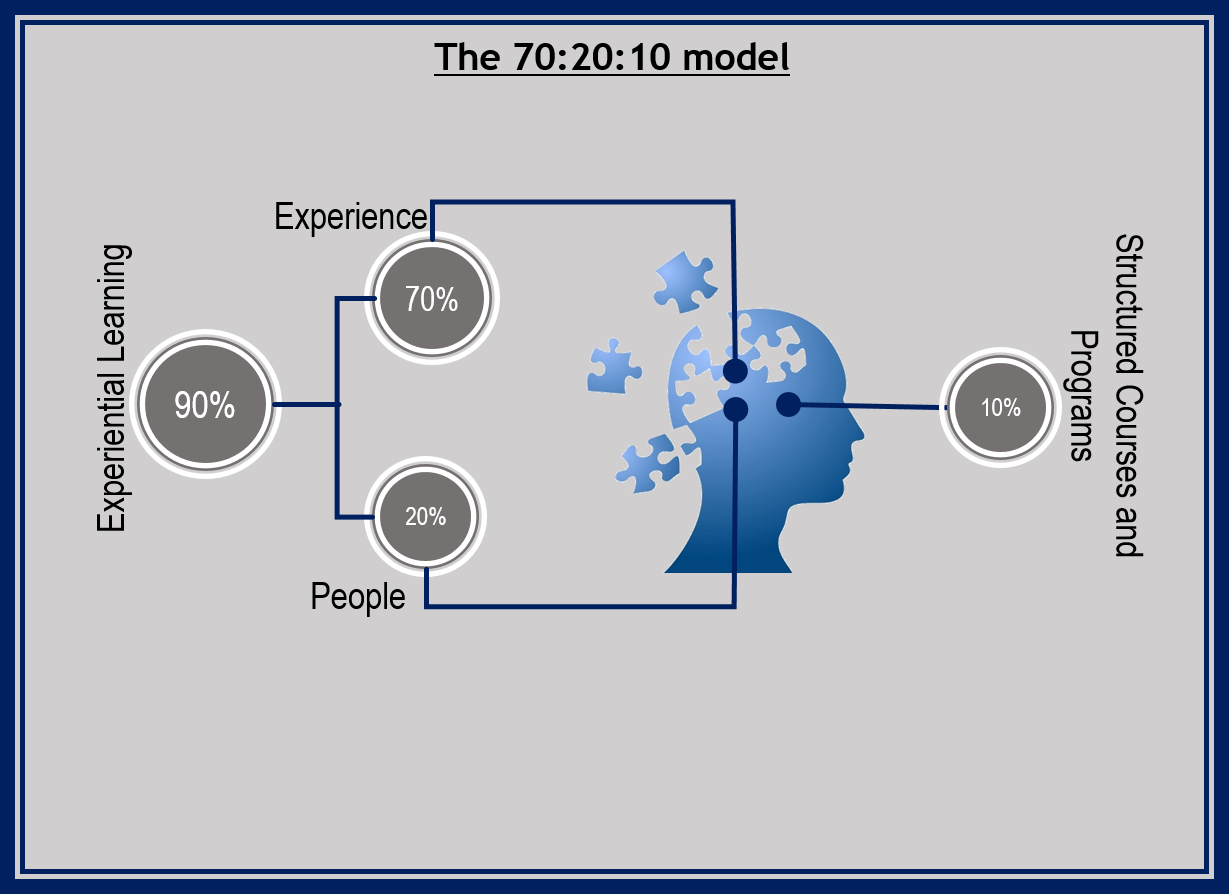
Formal learning accounts for only 10% of all learning – a fact.  Informal and incidental learning contributes to 80-90% of learning – another fact.  However, formal and informal learning, together, form a learning continuum, which could be interspersed with each other.

The 70:20:10 model fits beautifully with informal or social learning paradigm.

The 70-20-10 model

All learning may be intentional, or incidental, or both.  How can you track informal learning along with the formal/traditional learning?  How can you track incidental learning that may not be a part of the formal learning design?  How does xAPI come into the picture?

Experience API is able to track all formal or informal interactions happening in this learning continuum of a person or a group.  The basics of learning flow and xAPI is illustrated below:

xAPI Learning Flow 1

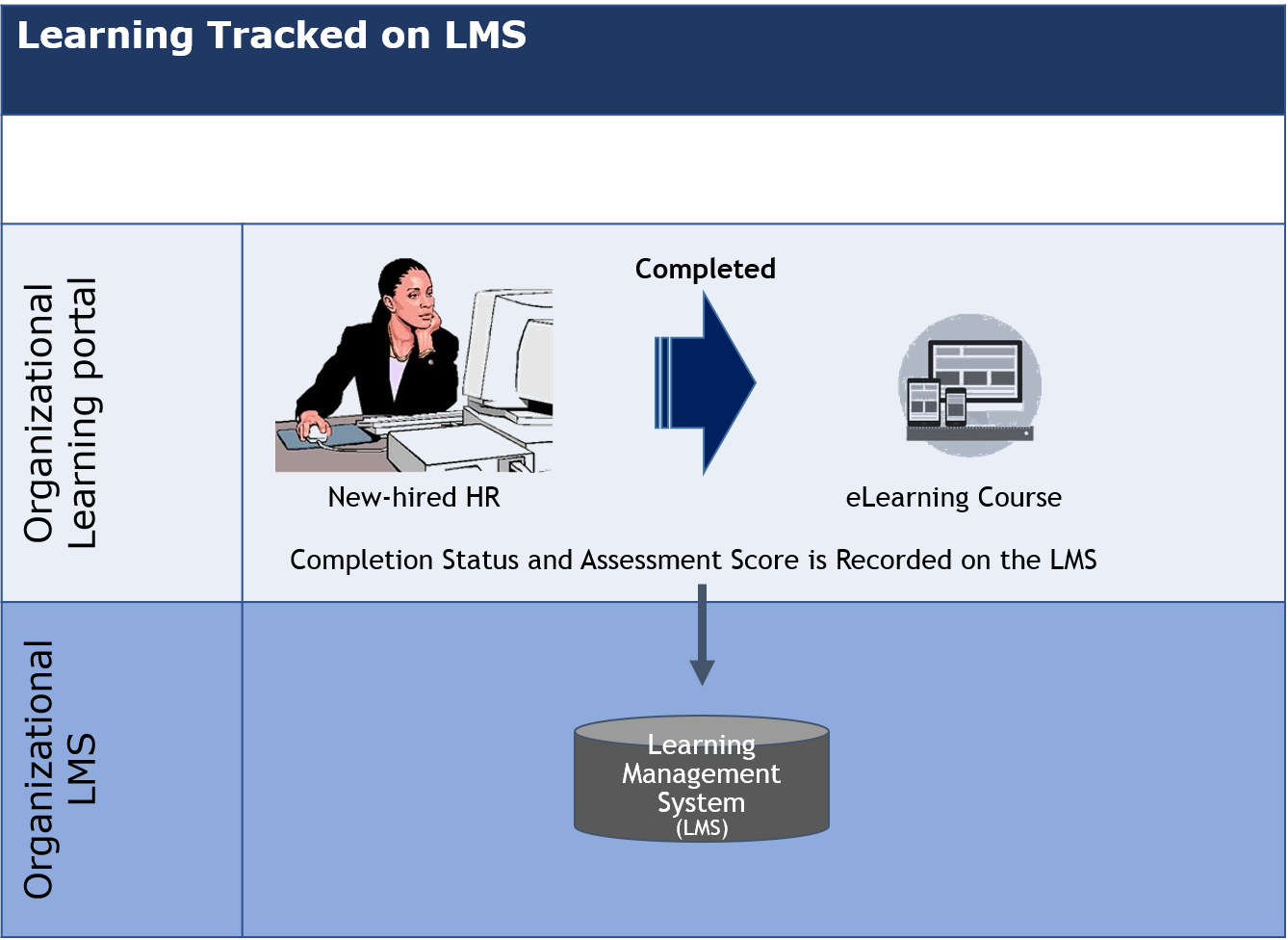
A typical Learning Management System (LMS) maintains the repository of content, schedules training, enables self-registration, handles notifications and approvals, tracks attendance and course completions, provides certificates, manages instructors, facilities, and resources, etc.  Imagine if this LMS is also able to communicate with knowledge bases, collaboration platforms, document management systems, enterprise resource planning (ERP) systems, helpdesk systems, portals, talent management, performance management, and other types of systems used at a workplace or a university.  It will then be able to track actual work inputs, outputs, deliverables, tasks, and more.  This is where xAPI does tracking of all work inputs and learning experiences.

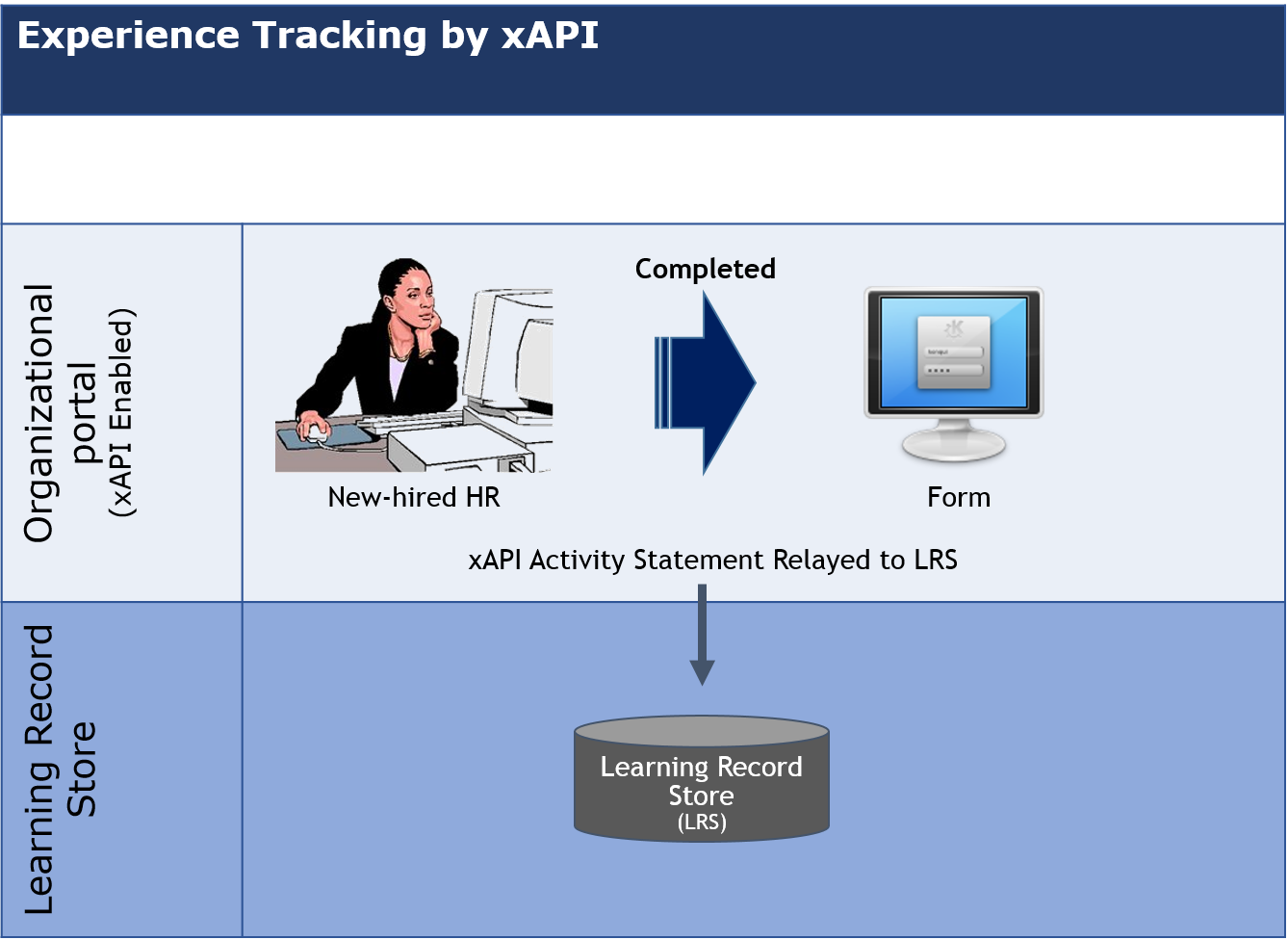
When a system or business unit works on certain pre-defined activities and a few of these are performed on the organizational portal, xAPI tracks and records each activity as a statement.  Each statement has an actor (performer), an action, and an object.  This activity statement is recorded as an experience and is relayed to the LRS (Learning Record Store).

Let us take an example: If a new hired HR personnel (actor) completes (action) the first MIS report for all absenteeism in a month (object), the xAPI enabled intranet portal records this report as an activity statement and relays it to an LRS.

 Experience Tracking by xAPI_1

Learning Tracked on LMS_1

Comparing LMS and LRS

LRS LMS
A database for storing xAPI activity statements (learning records/experience) A technology for managing curriculum, training materials, and evaluation tools
Can be built into LMS or can be standalone Needs LRS to support xAPI
Supports xAPI tracking and recording Supports training scheduling, completion tracking, certificate generation, training database, course development, managing resources
Supports work experience, coaching and feedback, portal and social media activities, on-the-job work assignments, coaching, and accomplishments. Supports formal learning programme and formal learning evaluation
Cannot support other LMS functions Requires LRS to store xAPI statements

Illustrating Experience API

Tracking traditional training on an LMS gives the manager an account of the completion of scheduled learning programs for the identified group of learners.  Tracking ‘transfer of learning’ to the job has always been a challenge for the instructional and course designers, as well as, the managers.  This has added to the woes of the organizations that are trying to calculate the return on investment (ROI) of all learning programs.  How does one track learning, informal, and social?  Can we track on-the-job learning?  Experience API is a step in that direction, tracking all learning participation, and monitoring performance growth.

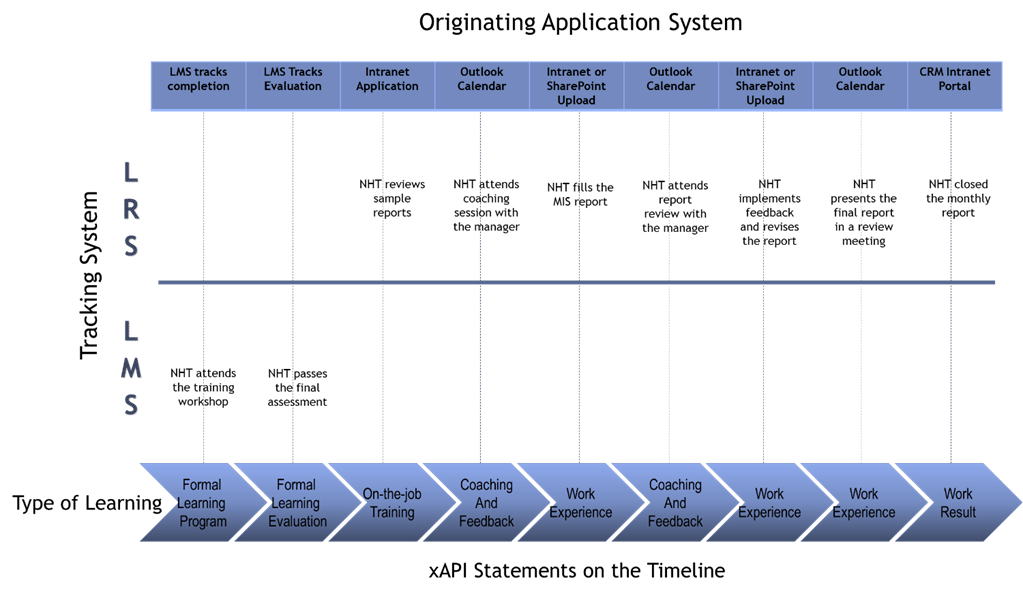
Let us take the earlier example of a new-hired HR trainee who is learning to manage the attendance reports.  The formal learning schedule is recorded by an LMS, and the activities related to work experiences are recorded by an LRS of a xAPI.  This can be illustrated as follows:

Tracking System 1

The training workshops and assessments are a part of the formal learning.  The completion status and assessment results are recorded on the LMS.  The reports can be generated for each learning course, or workshop, from the LMS for analytics.  On the other hand, all work activities, like the calendar entry for a coaching and feedback session with the manager, and files accessed or uploaded on an organizational portal or shared folder, get recorded as experiences by xAPI on LRS.  The new-hired HR agent uploads the MIS form on SharePoint.  This is accessible to the manager, and the team for any further use, analysis, and updates.  Experience API tracks the coaching schedules, meetings, uploaded reports, and records them as experience statements.  This can be used for monitoring the complete learning flow and deducing the learning curve.  The records, generated as reports, can help in a performance review.

Experience API – Industry Adoption

Some of the eLearning authoring tools have already adopted xAPI.  The latest LMSs are providing LRS and xAPI integration.  Saba Cloud is already capturing experiential and informal learning and storing the results in its Learning Record Store.

Articulate Storyline and Adobe Captivate 7+ support xAPI.  Lectora V11 supports xAPI.

All aspects of learning, from WBT to simulations to gaming to mobile learning to informal and social learning, is exploring xAPI to collate all forms of learning data and experiences. It is imperative that LRS will become an integral part of all institutions and organizations for xAPI adoption.  Learning is happening everywhere.  Experience API, or xAPI, is capturing it by making each learning activity traceable and quantifiable.  The future is here.

Sources:
http://www.learningsolutionsmag.com/articles/1271/the-xapi-and-the-lms-what-does-the-future-hold
http://www.adlnet.gov/tla/experience-api/background-and-history
http://tincanapi.co.uk/content.htm?sectionNumber=one&contentDataURL=what-is-tin-can/history-and-the-way-ahead.htm

||Sarvam Sri Krishna Arpanamastu||

Posted in Technical | Tagged , , , , , , , , , | 3 Comments

Hire and Fire

In my earlier article, Employee Engagement – Essentials, I had pointed out the pitfalls of losing an employee because of lack of clear employee engagement roadmap with properly defined KPIs (key performance indicators) and competencies for the profile.  The loss of a resource can be calculated in terms of the investment that went in the hiring process, training, probation, and attrition, upsetting the balance sheet.  Add to this, the loss of experienced personnel with a knowledge of the internal functioning, the repeat of the hiring process, resulting in losing a couple of years, with no guarantees of finding the right resource for a long-term engagement.  The ROI should cover the loss in man-hours, or man years, before the appropriate resource finally becomes productive.

Today, I am mulling over the success of a hired resource in a new organization.  As already established, employee engagement by way of well-defined KPIs and productivity roadmap is an important factor in this success.  However, it is imperative to identify some key factors and discuss them before accepting a senior leadership role.  Most organizations, during the business downsizing, believe in last in, first out, under their hire and fire policy, when comparing employees with similar productivity.

If the role is of an individual contributor, depending upon your seniority, understand the decision-making process and dependencies.  A clearly defined organizational chart with your place in it, key stakeholders, influencers, dependencies, and deciding team would help in expectation setting.  Seeking clarity from your future manager during the interview will ensure that ambiguities are set aside and the job-role agenda for the tasks to be performed is pre-decided.  In case you find a lack of lucidity and reluctance to offer the information, you can be sure that your position is not well thought out and you may not be in for a long-term employee relationship with the organization.  Even if you have a need to join, watch for six-months, and if things stay dubious about your role, start searching for a new employment.

In a people-management role, a manager’s success is dependent upon their team.  A senior position of a vice president is also not safe, if the team is not ready to follow you.  A new manager should find out the reason for the current opening in the business.  If the reason is the movement of the previous manager within or outside the organization, then probe to find out the feasibility of internal growth for any existing member of the team.  A company would hire from outside instead of promoting from within if they think that the current skill gap is huge between the existing pool and the desired role.  That should lead to other questions like, the existence of any performance development plan and the training of second line of leadership for bigger roles.  Any organization that is not creating a leadership pipeline is not proactive and lacks future planning skills.  Another reason for hiring from outside could be a need to bring 180° paradigm shift in the existing functionality.

In either scenario above, ask for the extent of freehand offered to the new manager in running of the function and the team.  Look at the organizational chart as explained above.  Clarify if you are allowed to bring in radical changes, like hiring new members with ideologies and functioning style similar to yours.  Understand if you can identify the weak links and fire them.  Most senior leadership is expected to bring in fresh recruits when hired.  If this freedom is lacking, then expect a lot of resistance and a herculean task ahead.  Such an organization is not willing to change and would prefer to run things as they are, expecting better results from the newly hired you.  Your success would be limited and you may be the victim of hire and fire, if you cannot hire and fire per your requirements.

Be sure to negotiate, and negotiate well.  Read some powerful books on the art of negotiation.  Do not fall a victim of organizational hire and fire.  If you have a choice, enter an employment with eyes wide-open.

||Sarvam Sri Krishna Arpanamastu||
Posted in In my Opinion, Technical | Tagged , , , , , , , , , , , , , , , | 1 Comment

Apolitical…

Every evening, in my paternal home, in my father’s room, the entire family would sit to watch the news on Doordarshan.  My grandmother, my father’s mother, would follow both, English and Hindi telecasts.  She could understand the full intent in the English News without understanding the language.  On good days, we would have two or three of my uncles also in the house and the post news discussions would continue in between the two telecasts and after the second News.  I was a small, insignificant girl, hanging onto each word spoken.  My elder brother would participate in these discussions a few years down the line.

My maternal grandfather and maternal uncle would have similar discussions too, and when visiting them, I would get to be regaled by my grandfather with the stories from the pre-independence times.  My maternal uncle would talk of little known instances from the various political meetings from the past.

I remember like a blurred dream the time of emergency, the election of Janta Dal, the rising of Indira Gandhi like a phoenix.  I remember a few things more clearly.  One episode etched in the memory is the pall of gloom on the faces of Doordarshan News readers when announcing the 1979 election results.  Indian voter is unpredictable.  We love dynasties.  We do not care to research, to understand the implications of our actions.  A major change requires a major upheaval, a major churning, a major movement to wake us up to the ground realities.  Once done, we get complacent again.  We stop researching and start believing whatever the media and the neighbours are telling us.  My mother and aunts were similar.  They believed in dynasties and in ‘Khandaan’ (blue blood).

I was too young to understand much at the time.  However, I remember another incident about my appreciation of history and politics.  I was in seventh standard.  We used to have constant visits from a Mr. Bahuguna, who was leading the education board in Delhi at the time.  My first introduction and interaction with the gentleman was during a history period.  We were studying about the moderates and extremists leaders in the Indian history during our independence movement.  We were being introduced to the philosophies of Naoroji and Gokhale on the one hand and Swaraj movement and aggression of Bal, Pal, and Lal (Bal GangadharaTilak, Bipin Chandra Pal and Lala Lajpat Rai, Aurobindo Ghosh) on the other.  Mr Bahuguna found it interesting and asked us a few questions.  He then asked a question to the effect that do we feel that any leader from the history has influenced us.  I remember raising my hand and talking about Gandhiji’s surrendering to Nehru’s ambition to be the first prime minister of the country, which could be one of the reasons for India’s partition.  I must have been twelve or thirteen years old at the time.

Thereafter, I have mostly remained apolitical, too busy with my life.  I never voted, due to postings and also, due to lack of interest.  There were no political alternatives.  All ambitions of seeing India as a world class country, a force to reckon with seemed distant dreams.  There were not many thoughts to spare.  Personal life took over completely.  The same personal life woke the responsible citizen in me when my daughter became eligible to vote.  My first vote was in 2012 Delhi municipality elections with my daughter.  I voted for her, and with her.  Thereafter, I voted in Delhi elections and general elections in 2014. Delhi elections of 2015 had another significance.  My son was voting for the first time and we went out as a family to vote.

I remained apolitical all my life, never bothering to choose sides or to vote.  An ex-colleague forced me into choosing sides during this period of 2012-15 by his incessant hackling and name-calling in favour of one party over the other.  The more he pushed, the more I researched, and chose what was right.  All those discussions from the childhood, the hushed facts, the living room discussions, all seem to be crawling out of the woodwork, being published in blogs, in articles.  The digital media has become so powerful.  Add to that are the declassification of the reports from the past.  Sixty years is a long time to keep things under wraps.  The confidentially is lost after the confidantes are lost.  Future generations may have their own truths from this era to deal with.  However, that is a future discussion.  I have become vocal recently.  May not remain so for long, and it could be a passing phase.  There are much more important things in life than the country’s politics, and these will eventually take precedence.  For now, I am unable to resist the need to share what I know to be true.

||Sarvam Sri Krishna Arpanamastu||
Posted in In my Opinion | Tagged , , , , , , , , , , , , , , , | 2 Comments

Blame it on him!

Sixty years of legacy has created an labyrinthine fabric of poverty, illiteracy, dependence on the state, lawlessness, having ones way, flaunting connections, selfishness, putting self before the state, misusing quotas and subsidies.  Sixty years and people could not find an alternative, allowing the country to move from success to shambles.  The voices of dissent were silent all throughout.  Eleven months and the burden of those misappropriations, mismanagement, starvation, poverty shifts to the inheritors.

When you plan a monthly budget, do you spend the entire amount on food?  How many people crying shame on the defense deals keep a chunk of their personal income aside for charity?  Let me take the risk and ask why the tax paying class should always end up paying more taxes even for the non-taxpayers.  All around me, I see families of low-income group having utter disregard for the state, burdening themselves and the country with unwanted population.  None of these believes in family planning.  They have no less than five to six children, each with a minimum age gap.  My cook got pregnant with the fifth child while marrying her daughter.  People blame the government for their situation. Some soft hearted, educated, and aware citizens who are secular, socialists, Marxist go around the town posting pictures of jet deals and starvation statistics.  Do you honestly think that if country’s entire budget is distributed to the poor or if all the money that the middle and the rich classes earn is distributed equally to the entire population of the country, we will have a better situation, developed country, no starvation, prosperity?  Think again!  People never thrive on charity.  People will stop farming, constructing, manufacturing, working, if they get free lunches.  To top it, most of the money will be spent on drinking, buying new mobiles, partying.  Do you misjudge the piety of the poor?  I am constantly reminded of the story of ant and the grasshopper with an Indian twist.  Do not forget to read it, even if you know the story already.

Sixty years hence and numerous schemes like NREGA have been huge failures.  The so-called intelligentsia is happy to be have the schemes announced to accept a government pro-poor.  Any other expenditures to grow as a nation and the government become pro-rich.  Unfortunately, we are still struggling to develop despite all the potential.  The rampant corruption and the lackadaisical attitude of past governments have rubbed off so much on the citizens that this burden is harder to off-load.  The reason is simple; we are not a land of equal opportunities, but a land of stifled voices.  Any entrepreneurial thought is buried in red tape.  Here is an effort by the current FM to change the same.  But the dissention of a few will see only negatives.  Everything looks yellow to the jaundiced eye. Well, here is the list of some welfare schemes launched in 2014.  Go ahead find faults. Blame it on him and regress back to corrupt state-of-affairs, with no thought for the country.  Even if the facts stare you in the face, your preconceived notions and personal biases, your egos, will not let you see them.  I hope that there are only few of you, who are living only to plunge everything back into abyss.

Links:

Ant and the Grasshopper in India

Welfare schemes launched in 2014

NehruPatelFacts

||Sarvam Sri Krishna Arpanamastu||

Posted in In my Opinion | Tagged , , , , , , | 1 Comment

Mischiefs of the Yellow Journalism


“Make the lie big, make it simple, keep saying it, and eventually they will believe it.”

Adolf Hitler


All it takes is finding some irrelevant, uncouth, irresponsible loudmouths of a particular sect.  What sells?  The competition is tough and with the blitzkrieg of media across the globe, keeping the channel running is an unenviable task.  Simple reporting is no longer the norm.  Opinionated discussions and scandalous statements pique the interest of the viewers, and the social media.  It is more important to be hashtag trending, then to be honest.  I cannot write enough on this topic.


“Media, an un-mannered master, manipulates the meek minds.”

Rana Junaid Mustafa Gohar


The solution!  Find stories.  If you cannot find the stories or do not prefer the ones making news, invent some.  Yellow journalism sells.  The gullible audience will lap it all up.  Want to defame someone, want to bring the government down, want to release a negative propaganda?  All it takes is finding some irrelevant, uncouth, irresponsible loudmouths of a particular sect.  Provoke them enough to make inflammatory statements.  Publish them, have discussion forums on your channel, denounce the government, blame it on rightists, prove the point that (pseudo) secularism is threatened.  When questioned, why would a government want to axe oneself by supporting the attitude of a limited few, inconsequential people explain, right wing governing, people are bolder.  Hello?!  Were there any restrictions in the constitution on free speech under a different government?  Or, is this a thought out strategy?  The same asinine klutz would have given you a similar statement under a different government.  However, that would not be as important or as impactful for your channels.  The denigration process can only be effective with the central with right leanings.  A central with left leanings would always be holier, even if it means destroying the country’s freedom, identity, and prosperity.  Cool!  Hashtag presstitutes again trending with false reporting. Hashtag trending useless…


“Everybody comes with prejudices, colored glasses on their eyes.  Then they see everything colored according to their glasses.  Yes, a few people come just like you, unprejudiced, without any idea gathered from yellow journalism.”

 Osho


Link:

False Reporting: another-anti-modi-lie-by-prestitutes-stays-exposed

||Sarvam Sri Krishna Arpanamastu||

Posted in In my Opinion | Tagged , , , , , , , , , | Leave a comment

Social Media and the Deluge of Information

sarikananda's avatarSarika Nanda Cerebrates

Not too long ago, major chunks of habitation in urban India, and the big metros like Delhi, lived in the old neighbourhoods and communities.  Generations of different families were born and brought up in the same surroundings, and neighbours were like extended families, each aware of other families, their darkest secrets, their strengths, and their weaknesses.  Privacy was not a possibility; yet, goodwill and trust were more forthcoming from the community.  Of course, there were many disadvantages, lack of privacy already mentioned for one.  In order to be a part of a community or a neighbourhood, one had to conform to the unspoken laws of the society.  There was little room for tolerance for the wayward.  However, people stood up in defence too.  If I go back sixty-eight years, then numerous stories during the partition on both sides will corroborate this neighbourly trust.  But for these neighbours, many of our…

View original post 840 more words

Posted in In my Opinion | Leave a comment

Age Inappropriate

sarikananda's avatarSarika Nanda Cerebrates

So, a colleague’s birthday last week and in my wishes, I asked him to not waste his life doing laundry, and instead, get a life and a girlfriend.  My other colleague from the previous discussion, ‘Mind Freeze’, laughed and insinuated that time for girlfriends is long gone for the older colleague, who is in 30+ club now.  He declared that people after a certain age should not be thinking about girlfriends at all.  He guffawed at the thought of a 30 or 40-year old girlfriend for any man.  According to him, any woman over the age of 30 is no longer a ‘girl’, but a woman.  The term ‘girlfriend’ seemed inappropriate to him.  In fact, the thought of any relationship other than marriage seemed unsuitable for a person in 30s.  I retorted that limited, closed-minded thinking makes the masses opinionated, sexist, intolerant, and patriarch.  He is a young…

View original post 700 more words

Posted in In my Opinion | Leave a comment

My Choice

Instagram has no problems with topless pictures or any form of nudity from its patrons, but its sensibilities are hurt by the photo of a fully clothed girl, in her bed, with a menstrual stain, and censor it.  ‘Moral police’ in Bangalore beat girls out of the pub.  A foreign documentary creator makes a controversial film on infamous incident in Delhi.  Now we have a video, My Choice, featuring Deepika Padukone and other famous women, stirring up yet another controversy.

I went through the video a couple of times, and then again.  The video urges women to choose their life.  It declares that women should have the right to choose and make their own mistakes.  The message is to shun judgement by anyone.  It is a woman’s free will, like any human being, to have choices, and not be judged for them.  A woman alone should decide her clothing, lifestyle, life-defining activities and society has no right to question the morality, and commit bigger crimes against them.  The outrage seemed to be for urging women to choose their own sexuality.  People are missing the point grossly if they feel that the video is promoting sex outside of marriage.  I looked up the term ‘outside of marriage’ a few times.  Every time it seems to return ‘outside wedlock’ meaning without marrying.  Adultery is not what it means, and even if it does, it is not urging people to do so.  It is repeatedly asking people to stop judging.  My choices, my mistakes, my consequences, and no to your prejudices.  As a woman with rights, I do not give you the power over me to decide my morality.  Pious or paramour, saint or slut, the world cannot be the arbitrator for a woman’s choices.

I am a mother of a daughter, and I understand when a mother shares her concern over the messages.  Hence, it is a mother’s responsibility to keep an open dialogue and ensure that correct message is conveyed.  Remember, women empowerment is not about sexual choices, but about not being throttled for any choices made.  Video is not about the dresses worn, or not worn, hairstyles and shampoo advertisements, body size; it is more to do with acceptance as a person.

We can argue to death the equality metrics.  Look around, and observe that a small section of people may be talking about human spirits and baulking at any feminist statements. Yet, a major section of our society is still struggling with the right of a girl foetus to not be killed in the womb.

There are women like Subhashini, who make it their lives’ mission to make a difference in the society, be it by selling vegetables and building a hospital, or by taking up entrepreneurial projects.  Many of these stories go unnoticed.  An anguish shared by many is on the popularity of Deepika’s video compared to the work by real women of substance.  I share their grief; however, most heroes are not in the show business.  They are not doing what they are doing for a few minutes of fame under the sun.  Then again, people associated with showbiz are not always trying to stay in the news.  They deserve a benefit of the doubt.  Their stories are more accessible, more sought, nonetheless, not less credible.  Everyone tries to make a difference in the manner that is best available to them.  Like what they do, or dislike, but stop being the judge, the jury, and the prosecutor.

Links:

censor

Moral police’

controversial film

My Choice

Deepika Padukone

Subhashini

entrepreneurial

||Sarvam Sri Krishna Arpanamastu||

Posted in In my Opinion | Tagged , , , , , , , | 1 Comment