Age Inappropriate

So, a colleague’s birthday last week and in my wishes, I asked him to not waste his life doing laundry, and instead, get a life and a girlfriend.  My other colleague from the previous discussion, ‘Mind Freeze’, laughed and insinuated that time for girlfriends is long gone for the older colleague, who is in 30+ club now.  He declared that people after a certain age should not be thinking about girlfriends at all.  He guffawed at the thought of a 30 or 40-year old girlfriend for any man.  According to him, any woman over the age of 30 is no longer a ‘girl’, but a woman.  The term ‘girlfriend’ seemed inappropriate to him.  In fact, the thought of any relationship other than marriage seemed unsuitable for a person in 30s.  I retorted that limited, closed-minded thinking makes the masses opinionated, sexist, intolerant, and patriarch.  He is a young man of 26, who is not new to young metropolitan life.  Does personal modish lifestyle guarantee a progressive thought process?  I am not so sure now.  Does this attitude smell of conceit?  I am aghast at the impudence.

This banter set me thinking.  I had two pertinent questions troubling me.  Is the term ‘girl’ age-restrictive, limiting the person in a woman?  Is the age a defining factor in labelling things or actions ‘age appropriate’ or ‘inappropriate’?  There are many more related questions like, was the term ‘girl’ friend taken too literally?  Is the inappropriateness of having no regard for people, especially women, related to age?  Is there a list of acceptable actions per age group?

Who would dictate the terms for living one’s life as willed?  Really!  You will decide what age is suitable to be called a girlfriend or a boyfriend!  What nerve?

Personality Groups

I am tempted here to talk about actions and reactions, mostly reactions, in a two-way communication.  There are many theories on human personalities.  Freudian Id, Ego, and the Superego; Florence Littauer’s Sanguine, Choleric, Melancholy, and Phlegmatic; and Eric Berne’s ego states.

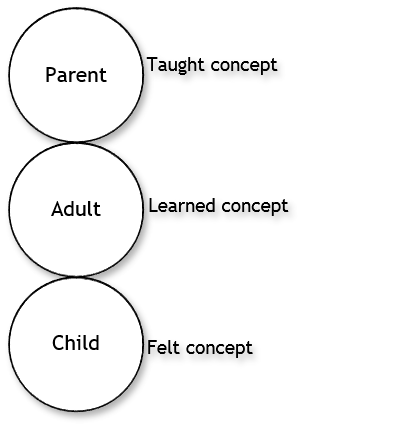
Transactional analysis (TA) by Eric Berne defines three ego states.  These ego states are present in all individuals, and are diagrammatically depicted through three circles lined vertically, touching at the circumference.
 TA

The topmost circle is parent ego state, with adult ego state in the middle circle, and the last circle is child ego state.  The three terms are different in classification from the social definitions of age.  Berne defined these terms as the ego states in an individual who receives a transactional stimulus, and responds.  The person’s ego state, at the time of receiving the transaction, defines their response to the situation or the stimulus.  If you look around, and within, you will find that more often than not, our actions are essentially reactions.  Unfortunately, we mostly respond from either a parent ego state, (judgemental, patronising, coloured with pre-conceived notions and biases), or a child ego state, (emotional responses of fear, gaiety, blame, low self-esteem, or of self-preoccupation, and indifference).  Only when we work from the adult ego state, are we able to evaluate, validate, assimilate, and then respond.  Adult ego state functions from an informed platform.

What is the purpose of introducing transactional analysis here?  All contact in the living world is a transaction, with a stimulus and a response.  Any action or a reaction is governed by various internal and external factors.  In order to know what conduct is befitting a person or a group, a deep analysis of these factors is mandatory.  TA is one form of analysing some of these factors.  I am delving into these influencers, in order to find answers to my queries and to understand human nature a bit better.

Inference

Hence, age appropriateness would be to use the adult ego state, drawing on the resources from both, parent and child ego states, analysing, validating, and then responding to a situation.  In an individual, each ego state is responsible for keeping the other in check, forming a balance.  An authoritarian parent, a rebellious child, or an unemotional adult can each be a problem individually.  Yet, taught concepts of a parent state, feeling and compliance of a child state, coupled with the learned and reasoning state of an adult will help eliminate any or all of the following tendencies from manifesting – patriarchal, addictive rowdiness, and/or sociopathic.

You can learn more about TA in the books ‘Games People Play’, ‘I’m Ok You’re Ok’, and ‘Staying Ok’.

Conclusion

I am trying my best through the years to be less judgemental, breaking my biases and preconceived notions, trying to make informed decisions, without conforming to the shackles of society.

I would like to quote Cinderella, the movie, directed by Kenneth Branagh –


“Just because it’s what’s done doesn’t mean it’s what should be done!”


Links in this article:

Freudian Structural Model of the Psyche

Florence Littauer’s Personality Groups

Transactional analysis

Cinderella, the movie, directed by Kenneth Branagh

Books:

Games People Play’, ‘I’m Ok You’re Ok’, and ‘Staying Ok

||Sarvam Sri Krishna Arpanamastu||

Posted in In my Opinion | Tagged , , , , , , , , , , , , , , , | 1 Comment

Mind Freeze – Power of Audio-visual Medium

There ensued a heated discussion with a colleague yesterday over the banning of the controversial documentary, #IndiasDaughter.  There are many against any kind of ban.  Most people are proponents of freedom of speech.  Not many realise the cost of too much freedom without the reins of duty or ownership.  Not many realise the mind freeze that a bad intent and sale focus can cause.  I would want to point you to two articles to present a different perspective, especially in this case, before we argue about the impact of visual medium.  A letter written to BBC by a girl from South of India, which was removed from the @WorldHinduNews website, is a fitting reply.  Another letter, written by Jawhar Sircar, CEO Prasar Bharati, is a revelation too.  I urge my readers to click the hyperlinks and read these letters before continuing.  My two posts, ‘Cultural Confusion’ and ‘social media’, talk of similar aspects.

Let me bring to your notice the impact of this one-sided documentary.  A German professor denied an Indian student an internship citing ‘rape problem in India’.

Coming back to the arguments with my colleague, a headstrong young man, whose contention is that there is no reason to ban a documentary.  He felt that people should watch and shudder.  The sentiment is right.  He also continued with India bashing, a trait common in younger generation.  They like to believe that they are global citizens, and finding faults is being rational and unbiased.  Nowhere in the world do we find such rationality as in Indians.  Youth in other countries are irrationally patriotic.  This could be the reason for Jaichands and Mir Jafars making Indian invasion in various forms possible.

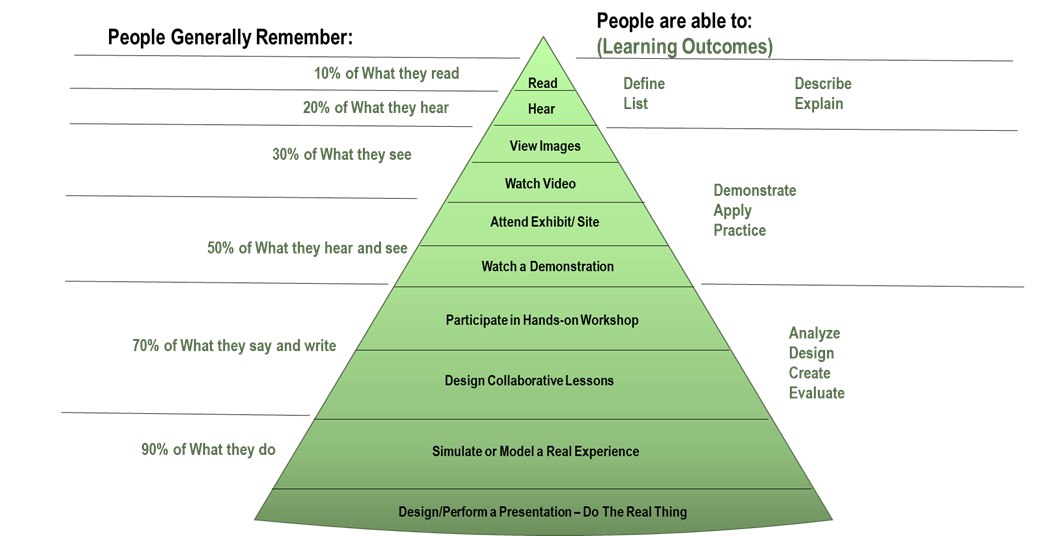
Little do we realise that everything shown is not the entire truth, and in some cases, hardly.  Here are my reasons for being very careful with the visual medium.  If I look at the Dale’s Cone, it explains a lot about the impression that a visual medium has on learning.  Dale spoke of various modalities of assimilation of learning and defined the impact each had.

Dale Cone

Let us come to more non-technical basic reasons.  The current generation is not aware of the ancient history, scriptures, and current events in as much details.  Little is taught on these subjects.  There are different translations and interpretations, each suiting the translator.  Most people, young or old, depend on visual media, like television and movies, for news and information.  I have already discussed this in my article, Social Media and Deluge of Information.  Many initiated movie and documentary maker present their versions of historical facts, historical personalities, mythology and their characters and incidents.  Most of these are driven by individual interests in a section of the story, and on the projections that they want to depict.  Uninitiated audience, with little or no background on the events being showcased, lap it all up as facts.  Taking a personal example, my knowledge of the historical figure, Razia Sultan, is coloured by the movie of the same name, where famous actor, Hema Malini, played Razia.  The film could only manage to show her love for a slave and could not highlight her acumen as a warrior, or a great ruler.  Similarly, Haider showed the Kashmir struggle and projected the Indian Army in poor light.  Please do not forget to read the associated articles by clicking the hyperlinks for a clearer perspective.

My argument is that audio-visual medium is the most powerful medium.  This is the most accessible medium and can create and/or mould people’s psyche.  There is enough said about the fertile minds of the masses.  A mass-movement in a particular direction can break or make a nation and the people.  Enormity of the harm that uninformed, half-baked stories, serving selfish motives of the storyteller can do, are difficult to fathom.  I would have been an endorser of the freedom of speech a few years ago, but experience has shown that many an intentions of the ‘revolutionary’ are not always honest.  My yet another colleague participating in the same discussion rightly advised, “Do not be so naïve to believe everything shown.”

My advice is to take each information with a truckload of salt, research the facts, weigh the consequences, and form the informed opinions.  Stop trending…stop flowing with stream…but do not stand apart just to be different…conforming could be good too…it should be an educated decision, always, to avoid the mind freeze.

Links:

  1. @WorldHinduNews
  2. Jawhar Sircar
  3. German professor denied an Indian student
  4. Hema Malini
  5. Haider
  6. Indian Army

||Sarvam Sri Krishna Arpanamastu||

Posted in In my Opinion | Tagged , , , , , , , , , , , , , , , | 3 Comments

Heartache…

How closely is heartache connected to heart’s desires?  What about longing, sense of loss, craving for love?

Mirza Ghalib’s poetry sums it beautifully –

Hazaaron khwahishen aisi ke har khwahish pe dam nikle

Bohat niklay mere armaan, lekin phir bhi kam nikle

(Thousands of desires, each worth dying for…

many of them I have realized…yet I yearn for more…)

Buddha said, “Desire is the root cause of all evil.”

Bhagavad Gita Chapter 2 Verse 62 says, “While contemplating the objects of the senses, a person develops attachment for them, and from such attachment lust develops, and from lust anger arises.”  Verse 70 of the same chapter talks of the way to achieve peace, “A person who is not disturbed by the incessant flow of desires — that enter like rivers into the ocean, which is ever being filled but is always still — can alone achieve peace, and not the man who strives to satisfy such desires.”

Chapter 3 also talks of desires and lust.  Verse 37 and 38 of chapter 3 says, The Blessed Lord said: Born of the activating attribute of Nature (rajo-guna), it is desire, it is anger, (that is the impelling force)—full of unappeasable craving and great evil: know this (two-sided passion) to be the foulest enemy here on earth.  As fire is obscured by smoke, as a looking glass by dust, as an embryo is enveloped by the womb, so it (wisdom) is covered by this (desire).

All the philosophies of the world aside, desires are immutable, uncontrollable.  How does one get over the heartache associated with life?  How does one lick clean the old wounds?  Why does it hurt even after almost two decades?  Why does one feel happy for others and at the same time, feel sad for what could have been?

Almost two decades hence, I am amazed at the repeated rebound of emotions.  Two decades should be a long enough time to move on, to be ready to be happy.  And, this flood of emotions does not get contained even after two days of despondence.

This emotion seems to be a repetition…third in the series…but then this emotion is permanent too.

||Sarvam Sri Krishna Arpanamastu||

Posted in Personal Files | Tagged , , , , , | Leave a comment

Our Princesses

“Where’s my food?  What have you made for me today?  Why aren’t you giving me something to eat?”  My daughter complains every weekend while still in bed.  I rush to prepare something new.  Last time she wanted rainbow-sandwich-bread-pakoras with coriander chutney and ketchup filling.  The same evening brought another storm, as she did not get the dinner that she had hoped for.  I gave her something that calmed her a little.  She is a young woman of twenty and some. 🙂

Most days she is the one tidying up the house, arranging things, chiding her mom, brother, and granny for leaving stuff lying around the house.  She has been a teacher and a caretaker to her younger brother.  One cannot blame her for her volatile temper.  To the world, she is an angel with the sweetest nature, and so she is.

Our daughters are our princesses.  They are our world.  I see my family, friends, colleagues, people around me, and all my contacts on social networks as doting parents, taking pride in their daughters, showing off their daughters’ smiles, accomplishments, and important events.

Is ours a different world?  Do we all belong to an exclusive club?  Why are the newspapers and the media narrating a different story?  I would like to believe that ours is the real world; that our daughters are loved as much, whichever system they belong to.  This is our legacy, this is the real world, as real as it gets.  Anything else reported is atrocity and monstrosity, unreal and not the norm.  Any person behaving otherwise, condescending our daughters, committing crimes against them, and making them miserable in any way, should be stoned, booked for crime, and punished severely.  I hope and pray that the reality is the village in Rajasthan that plants 111 trees for each girl child that is born.  I hope that our princesses rule the world, live in a fairy tale sans all the beasts, villains, and awful stepmoms.

Our daughters are our pride, and our precious jewel crowning our heads.  They are the heartbeat, the smile, and all things beautiful.  God’s most beautiful creation, girls bring sense into the insane, beastly world.  Any uneducated, unsubstantiated notions and all clichés related to women can be denounced only through factual education.  Take a cue from our rich history and know that women are the pride of the nation, and family.  Look at the recent events like launching of the ISRO’s Mangalyaan to mars and learn.  More power to our daughters.  May they continue to make the world a beautiful place, and be the shining stars.

||Sarvam Sri Krishna Arpanamastu||

Posted in Parenting, Personal Files | Tagged , , , , , , | Leave a comment

Judgemental…

Judging people comes easy.  As long as you are not being judged, judging others is not an issue.  Life is not about being fair.  It never was.  We judge people around us like relatives, colleagues, and friends.  We judge a book, a movie, a place, a restaurant, a famous personality, an action, a bill, and even God.

What is the meaning of being judgemental?  Oxford dictionary says, ‘Having or displaying an overly critical point of view of things.’  Does stating a fact or expressing a feeling qualifies as being judgemental.

With our fragile egos and sensitivities, we are not strong enough to take a simple statement in our stride.  We have also lost the art of conversation and of polite refutation.  Everything is personal and each statement becomes a blow on a person’s self-esteem and breaks a relationship.  If I were to make a simple statement like, ‘A’ like oranges more than apples or bananas, it can be termed as an attack on the ‘A’ clan.  I have not seen anyone giving a simple reply disproving the claim by saying that it is not true.  I have not heard them talk of the problem with their projections as per the comment, and that they should work towards changing perceptions.  There is never an inward assessment.  A statement and its maker are browbeaten to death, but a personal assessment is never made.  We all assume that we are perfect.  If not, we still find ways to blame everything else under the sun.  Nonetheless, we are never to be blamed.  I am not even talking about public figures but only family and friends.  It has been a long time since I have come across robust relationships.

When did we become so fragile?  When did we lose trust in our friends and ourselves?  Why has everything become so personal that it requires a confrontation?  Whatever happened to acceptance, magnanimity, empathy etc.?  Why cannot a joke or a friendly insult replied to with an equal amount of retort?  Why so much affront is taken on self?

In my opinion, a comment should be checked for its verity.  If it true, then check if the comment is a simple statement stating the facts, or it is also showing disapproval.  Only if a disapproval is attached should it be considered being judgemental.  Also, check if it was meant as a joke.  We need to rise above our personal brittle egos and stop making mountain out of what is not even a molehill.  True friendships and relationships should have the robustness of taking both, bouquets and brickbats.  A relationship based only on praise is cronyism and not relationship.  At best, it is a permanent compromising plastic smile with no strength of honesty.

||Sarvam Sri Krishna Arpanamastu||

Posted in In my Opinion, Personal Files | Tagged , , , , , , , , , , | Leave a comment

Not Unhappy. Not Ready to be Happy

While watching yet another episode of Downton Abbey, (season four episode five), a statement by Lady Mary struck a chord with me.  ‘I’m not unhappy.  I’m just not quite ready to be happy’, is profound for someone who has lived a similar context.  It reminds me of a woman who spent nineteen of twenty-five years of her married life practically alone.  There was never a lack of options or offers.  She rejected some because she did not want to lose those friends and some because she did not want to lose her freedom.

I have always wondered what happens to people who lose love of their life, their soulmate.  Life does not stop.  Desires do not stop gnawing.  Longing does not subside.  How do these people survive, especially those that are still very young?  Having seen many examples in the family, I have always marvelled at the forbearance of these women and men.  May be, they were a different generation.  May be, they were a generation that could sacrifice their entire lives for the family.  Then you meet this woman of the later generation.  She is as modern as modern gets.  A working woman, she never sacrificed her lifestyle.  I would like to believe that she continued to be the life of parties and family gatherings.

What then stops people like her from choosing someone?  Is it difficult to be happy with someone else?  What happens when you lose the love of your life, your soulmate?  Would any choice thereafter be always wrong, a disaster?   May be, people divert their happiness consciously into other things.  May be such people find broader meaning of happiness and never let one inadequacy in life overpower their entire lives.  There are only questions with no definite answers.  To each his own.  No one can predict the actions and the related happiness for others.   All I know is that this statement will resonate in my mind for a long time –

I’m not unhappy.  I’m just not quite ready to be happy.

||Sarvam Sri Krishna Arpanamastu||

Posted in Personal Files | Tagged , , , , , , , | 1 Comment

Cultural Confusion or Degeneration

I have taken to watching Downton Abbey recently and cannot help but marvel at the British style of conversation, accentuated with those subtle one-liners.  British humour and sarcasm have always found favour with me.  My daughter had also started enjoying it until such time when Dan Stevens’ character was killed.  I wonder if it was the cultural and linguistic style that charmed her, or was it purely Dan Stevens’ charisma.  Being a loud Punjabi family, we have always found soft-spoken people with restrained style of talking (a stiff upper lip) very attractive.  Unfortunately, I am not going to talk about the attractive as much as the unattractive.

We Indians take pride in our cultural history and the ethics that date back thousands of years.  I will not get into the dispute of how many thousand and would rather refer my readers to a book by Rajaram NS, ‘Search For The Historical Krishna’.  Coming back to the topic, Indian culture has always been progressive and Indian mythology can give the testimonials to the same.  We never shied from questioning the ethos, and were more forthcoming in adopting new doctrines.  Unfortunately, the current scenario is a mishmash of native and western cultures, with blurring lines of sanity.  Are we on the throes of societal degeneration or only dealing with a little cultural confusion?

How far back should we go in the history to talk of the societal mind-set?  (Remember, whenever I say ‘mind-set’, I am referring to gender inequalities.)  Let us begin with Ramayana, where Lord Ram gave up Sita for His kingdom’s ‘wellbeing’.  He knew of her chastity and still chose to accept the popular mind-set over His reasoning.  Moreover, why was chastity ever a question?  Then there was Draupadi in Mahabharata, wife to five brothers.  This fact alone was enough for the Kauravas to use it for a political game and revenge.  Both the epics dealt with the wars waged for the honour and safety of protagonists’ respective wives.  We are talking of the times some 5000-7000 years ago.  Neither Lord Ram nor the Pandavas shied away from their duties.  However, both epics dealt differently with the societal pressure.  One epic took the issue head on and over time, Draupadi’s five husbands found acceptance as one-off instance in mythology.  In the other epic, husband rescued the wife only to abandon her at the whims of a washerman.  It is a different matter that thereafter Lord Ram observed austerity of an ashram life within His palace and lived as a hermit in celibacy.  I am aware that I am stirring up a hornet’s nest, starting an endless debate, and I am yet to debate the actual point of this article.

The recent spate of events has set an image of India in the global media.  We are 1.27 billion, with the youngest population in the world.  We have been independent for all of 68 years after more than two centuries of foreign subjugation.  I remember my growing up years with the middleclass attitude of being honest, courteous, generous, and charitable, without greed, with eternal contentment.  Times changed and all of us pined for more.  Western money through multi-national companies, dreams of luxury a la western lifestyle, desires for more – did it all change the nation’s mind-set to greed, lust, and anger.  When did the poor, the rural, the farmers, the villagers, and the urban middleclass lose its pride in good values and started hankering for more?  Did easy money and exposure to material excesses brought the criminal out in our culture?  The class divide is decreasing and the desires are increasing.  Before anyone pounces on me, let me clarify that I am not implying that one is a result of the other, or there is necessarily a connection between desires and reducing gap between classes.

Make no mistake in thinking that this corruptible outlook is India’s legacy.  We are in the news for not so many good reasons.  Yet, the reasons stem from a greater awareness of the masses, their courage to take the bull by the horns and demand justice.  The initiative of the public to not ignore the problems, to ensure that the misdemeanour is punished, has brought the spotlight to our doorstep.  There may be a great flux in the values due to the changing generations, increased growth potentials, and growing consumerism due to greater accessibility.  Is there any society around the globe that can boast of a crime-free existence?

Is the focus on every misstep due to the threat that we pose to the world when we are ready to take back our rightful place?  Indian history, mythology, culture, and people have been a victim of negative propaganda from the time British docked their first ship in 1608 at the Indian port.  Many had invaded India before that and the history is replete with the stories of invasion by Alexander, Genghis Khan, Turks, Afghans, Mughals, Portuguese, and British.  We have survived all these invasions and adopted successfully the cultural synthesis.

The current scenario is a melting pot, with the cultural honchos going in an overdrive to safeguard our ancient culture by even regressing in their thinking, and the affluent making the best of the western freedom of no-hold-bars in taking to the bars.  The uninitiated, the uneducated, and the not so rich are confused.  The freedom has its pull, but the cultural, societal, and value systems are not easy shackles to break.  To top it all, the corrupt and the criminal minded are trying to have a field day at the expense of innocent people, especially girls.  Even the churning of the ocean brought out the poison before the nectar.

The world media’s focus on the negatives is sullying the Indian image.  The foreign media’s policy to malign everything third world and Indian belief that whites are superior and always right is not doing us any good.  The entire scenario is reeking of racism.  The reports of nine or 11 years olds getting pregnant in the UK and the consensual sex education for them in schools (excerpts), or satanic worship education in the US schools (report), or high crime rate due to sociopaths, psychopaths, and paedophiles never get the kind of attention that India is garnering due to the events of December 2012.  We are far below the US, Ireland, Russia, France, Mauritius etc. in the crime index.

So, what are the implications of the current situation?  What are the solutions?  What are we doing right or wrong?  There can be many arguments.  Different schools of thought will have different strategies to dissipate the situation.  We have a large population of uneducated people.  The education system is changing too.  The focus is not on inculcating the basic values.  Instead, students are being prepared for the competitive examinations for higher education.  The portion of population that are restricted to farming, manual labour, and blue-collared jobs are not getting the required education.  Even our media, like the movies and the television, has nothing to contribute in terms of cultural education.  There is a continuous conflict between the cultural and material needs.

The answer lies not in giving up the thirst for a better life.  Instead, it is imperative to retain our heritage of good values, self-respect, generosity, goodwill, and to take pride in it.  We need to educate all.  Our media and the education system have to take up the challenge of changing the regressive and patriarchal thought process.  People have to be reminded that we are the land of Razia Sultana, Rani Lakshmi Bai, Sarojini Naidu, Savitribai Phule, Indira Gandhi, Kalpana Chawla, Fathima Beevi, Kiran Bedi, Lata Mangeshkar, M S Subbulakshmi, P T Usha, Saina Nehwal, Sania Mirza, Nirupama Rao, Mary Kom, Chitra Ramakrishna, and many more Influential Indian Women.  There are countless ordinary women doing extraordinary work under challenging circumstances, balancing work and home with poise.  These are the examples that should be brought to the fore for inspiration.  In fact, media should go on an overdrive to fade out the patriarchal, regressive, demeaning voices and report only the meaningful, positive voices and set the stage for progressive thinking.

We have been successfully thriving against all odds.  Our diversity, population, culture, and simplicity have proven to be our strengths.  We have proven to be hardworking and law abiding citizens of the world and major contributors to the economy of the countries we migrate to and adopt as our karam bhoomi (land of choosing).  We have rich cultural heritage and a huge section of educated citizens that are making a difference around the world.  We need to strive harder to bring an attitudinal change in our citizens towards our property, our nation, and instil the feeling of pride for our country, culture, languages, and people.  We have arrived and we need to accept it and show it with confidence through our actions.  White skins or not, Indians have to stop being intimidated.  We have issues and we accept them.  And like any great nation, we are ready to rise to the challenge.  We do not need the foreign jury to pronounce judgement on us.  We are capable of handling our own.

||Sarvam Sri Krishna Arpanamastu||

Posted in In my Opinion | Tagged , , , , , , , , , , , | 1 Comment

Employee Engagement – Essentials

sarikananda's avatarSarika Nanda Cerebrates

“A productive employee who is kept busy working at his or her job is far more likely to be happy at that job and less likely to look for employment elsewhere.”

Zig Ziglar

Working with corporates for a couple of decades has taught me some valuable lessons.  One observation is that corporate culture, and leadership influences a person’s behaviour.  Most people react differently in a similar situation in different organizations.  It is almost as if they possess different set of values, attitude, and attributes in diverse environments.  Even the leaders, responsible for setting trends, show variations in their dealings, depending upon their place of work.  The thought leadership and the corporate honchos are aware of this fact, yet do little to change the attitudes.  More often, a set attitude is woven into a corporate’s fabric and a change of mindset would require changing the entire workforce.  This is impractical and…

View original post 334 more words

Posted in Technical | Leave a comment

Social Media and the Deluge of Information

Not too long ago, major chunks of habitation in urban India, and the big metros like Delhi, lived in the old neighbourhoods and communities.  Generations of different families were born and brought up in the same surroundings, and neighbours were like extended families, each aware of other families, their darkest secrets, their strengths, and their weaknesses.  Privacy was not a possibility; yet, goodwill and trust were more forthcoming from the community.  Of course, there were many disadvantages, lack of privacy already mentioned for one.  In order to be a part of a community or a neighbourhood, one had to conform to the unspoken laws of the society.  There was little room for tolerance for the wayward.  However, people stood up in defence too.  If I go back sixty-eight years, then numerous stories during the partition on both sides will corroborate this neighbourly trust.  But for these neighbours, many of our families would have found it difficult to survive and cross the borders on each side to reach the land of their choosing.

Major source of information until the 1980s was the community grapevine and the newspaper dailies.  Limited people possessed radios, and still fewer had televisions.  Even the televisions were limited to some state run channels.  Some twenty-five or so years ago, an advent of private channels and cable TV changed the way communication happened.  Ever since, mass communication has increased leaps and bounds and other forums like digital space, Internet, chats, tweeting, and blogging has added to this torrent.


The media’s the most powerful entity on earth.  They have the power to make the innocent guilty and to make the guilty innocent, and that’s power.  Because they control the minds of the masses.

Malcolm X


Since little is left under wraps, more communication has contributed to more awareness.  The downside is that reporting has lost its key ingredients like research, facts, responsibility, integrity, honesty, and given way to target rating points (TRPs), number of followers, likes, and other statistics.  This is a dangerous trend, because lack of information was a definite drawback, but too much of untrustworthy and incorrect information is a bigger evil.  Reputations are made and destroyed by the media, and deliberate or undeliberate wrong reporting can leave an indelible blot on a person, institution, or organization’s reputation and no amount of apologies and defamation suits can clear the initial impression made on the people.  Most of these apologies or defamation suits do not even reach public, and first impressions become permanent.  Many populist sentiments and inaccurate information has been instrumental in both, creating and bringing down governments.

Hitler had a great sway over the masses.  He almost had hypnotic control over them and all his speeches were highly motivational.  His use of media was limited to some radio and some television.  Imagine the extent of his influence if he were living in current times.


If you see ninety-nine people running one way and three going the opposite, don’t be too quick to join the majority.

Anonymous


There are so many negatives of the digital media and social networks.  We hear an utterance and meanings are drawn, statements are distorted, context is lost, twisted, connotations are added, interpretations are based on thousand past references, outrage ensues, people fly off the handle, social agitations are launched, social networks and the media become the messenger, judge, jury, social police, harbinger of justice, and the judgment is pronounced.  All the people participating feel proud of their pseudo-intellects, and believe in half-baked truths with all the sincerity of the social workers and the aware citizens of the world.

In existing times, famous personalities, media people, politicians etc. are walking on eggshells.  One misconstrued statement and the news channels will start shouting, “outrage!”  Social networks will start buzzing with the denouncements, and the event will take the proportions of national crisis.  Everyone will act devil’s advocate, and the head of the person involved will be chewed off.  Everyone will want to become the ‘rescuer’ of the ‘sufferer’ and social conscience of the speaker.  The only thing it will generate is publicity and TRPs.  Not even 1% of this active population will ever join forums, get their hands dirty, and do the real work.  We will suddenly have all the information in the world on the person’s past, present and future.  Everyone will gear up with the web links about the person.  During all of this, we will take the attitude of being so holy, perfect beings, with a complete right in the world to make the pronouncements and judge others.

On the flipside, the same media will be used to stay in the news.  Irresponsible statements, movies, events, jokes, etc. will be created in the name of the freedom of speech, deliberately outraging the public sentiments to generate news.

Cyber wars over inconsequential issues have become the norm, and important issues never see the light of the day.  Most people are not even aware of or interested in the finer issues that are affecting the society or the economy, and would not even be interested.  For you see, these issues do not make for grapevine and good blather points.

Print media still retains some integrity in reporting and the reporters from their regular beats are able to get the fine print and add it to their story.  In contrast, digital media and television rely on human-interest stories that can garner their TRPs.  People who rely on television as their source of information are depending upon some headlines and a few channel chosen debates to enlighten them.  Most of these debates are shouting matches.  It is like thinking the promo of a film to be the entire movie, or accepting a media personality’s verdict on a product in an advertisement to be the whole truth, and adopting it.

I only wish that human minds were not as fragile, as susceptible to believe anything doled out to them as information.

||Sarvam Sri Krishna Arpanamastu||

Posted in In my Opinion | Tagged , , , , , , , , | 3 Comments

25…

Years go by and life continues.  Or rather, cosmos continues its churning of life and afterlife.  How does one take stock of life?  Many popular quotes talk of counting your blessings, the number of friends, and/or your achievements etc.  Is a lifetime limited to some or even all of these?  What about the piles of thoughts that unceasingly remain in one’s psyche?  Do these innumerable feelings and images form a part of this life?  Why is there a need for reflection?  What is the significance of the mentioned figure?

Twenty-five years, or a quarter of a century, could be a substantial part of one’s adult life. It could be a lifetime spent with someone of importance.  Does it hold any significance if nineteen of these twenty-five years are spent without that someone?  Do we celebrate the presence or the absence of a person?  Does the number lose its meaning or does it still hold a semblance of sense for the person in the above scenario?  These myriad of thoughts can be exhausting, and let me not lose you, my readers, to these.

Twenty-five years today, and the life has continued irrespective.  There have been endless blessings, lessons, gains, loses, tears, anguish, laughter, love, hate, family, friends, relatives, enemies, likes, dislikes.  The sum total of this ledger has been on the positive.  Central to it all have been my boons endowed through His grace, the children, who contributed substantially in making this figure worthwhile.  Add to this is the initiation towards spirituality, beginning the eternal quest.

This day, for the last nineteen years, has been a part of the family celebration list, with ice cream and soda a constant.  The family philosophy is simple.  Life should remain a celebration come what may.  No opportunity will be wasted to sorrows, if possible.  We have tried to live up to this bargain together, and God willing, will continue to do so.  Twenty-five years is a great feat, or it could have been.  Wishing notwithstanding, the day remains important.

||Sarvam Sri Krishna Arpanamastu||

Posted in Personal Files | Leave a comment